


Weapons (2025) - Interesting Framing to Hide its Weaknesses

Updated: Jul 27
I admittedly was not a big fan of Zack Creggar's previous film, Barbarian (2022). I can't say I was particularly enthused about Weapons (2025) when I searched what true story it was based on (since the marketing very much wanted you to know it was all true) and found that Creggar had said "It wasn't like a piece of media or anything like that [that inspired the movie.]" as opposed to a "any singular incident.", only mentioning footage from Vietnam. Whilst an awful tragedy, the film presenting itself as based on a true story detracts from that Vietnam commentary, and feels like a distant tragedy used for a half-truth of a marketing gimmick. Admittedly, Creggar has talked about how writing the film came from the grief of losing a close personal friend, which is also a tragedy, but does not quite like up to 'This is based on a True Story' in quite the same way the Conjuring films use it. (In that the Conjuring use specific cases for inspiration, even if they take several liberties.)
So, admittedly, I came into Weapons with reservations, to say the least, but it had garnered a lot of attention online and I was curious and ready to give Creggar another chance. Perhaps it was that bias, but I mostly came away with the thoughts that I'd assumed I would.
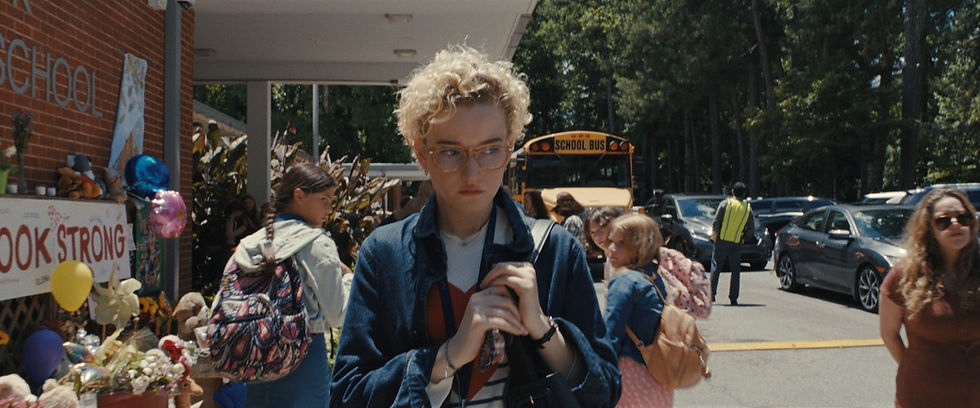
Weapons opens with an unnamed child narrator (Scarlett Sher) telling us about the disappearance of 17 children from teacher Justine Gandy (Julia Garner)'s class, leaving just the one child left. From there, the film tells the story of the investigation in segments, switching points of views in order to reveal the story, culminating in the remaining child's - Alex (Cary Christopher) - story.
This narrative structure is interesting and deployed more effectively than in Barbarian. Each section leads to the next clue in the story, unfolding the investigation to the audience one step at a time. This is, mostly, effective in keeping the plot tesnse and intriguing. Unfortunately, halfway through the film grinds to a halt halfway through for two segments which do little to progress the plot and are tonally jarring. We go from a tense, grief-filled investigation to cop vs stoner hijinks. Like Barbarian, the sudden switch to humour is bizarre and brings the quality of the film down. It doesn't help that Creggar's humour is Eli Roth-esque: unlikeable characters with high-schooler humour. It doesn't help that the characters in the other sections hold little substance.
The other problem this structure runs into is the final story becomes an exposition dump; once we reach Alex's point of view, the whole mystery is re-explained from start to finish. It's a shame, because a scene or two of this story sprinkled between sections would heighten the mystery as we see snippets of the strange Aunt Gladys (Amy Madigan) figure. It would also mean that the audience doesn't have to wait so long to see the film's most interesting and standout character. Madigan's performance is unsettling from the start, and is one of the strongest and scariest portrayals of a witch that horror has seen for a long time. It was a pleasant surprise to find that the hype around the character was well earned.
In discussing Barbarian, I touched on how, seemingly, a scary monster to Creggar, is a wrinkly, naked woman. Unfortunately, the same idea appears to continue in Weapons; Aunt Gladys' appearance is supposed to scare because she is an older woman with garish make-up. The shots of her without it reveal the 'horror' that she is bald. Whilst some of this can be accounted to the general portrayal of witches in media, and the in-universe explanation that she is draining others' life force, it's also somewhat disapopinting that in 2025 an ageing woman is the scariy villain in the movie. Isolated, this wouldn't necessarily make me take notice, but coupled with Creggar's other monster woman, starts to seem like a misogynistic undertone we should be leaving behind.
A Letterboxd review discussed this, and some of the deeper ideas of Weapons further, and makes for an interesting read. Whilst I do not think all of it was Creggar's intent, it's certainly intriguing to analyse the messages the movie could be portraying. Creggar has said the movie is "not a political statement," but all art is political, subconsciously or not, and this remains a good exercise in examining what thoughts and messages can be read out.
Although this is where the majority of the film's scares lie. Aside from a few jumps cares in dream sequences, Weapons struggles to deliver on the scares for most of its runtime, leaving a somewhat tedious investigation to tread through to get to the horror of the horror film. In this way, the narrative framing feels employed merely to hold surprises for later, as opposed to a choice to deepen characters and themes.
Overall, Weapons is an interesting take on the witch genre, but becomes muddled by its own format in an insistence to have wild plot twists.


Comments