


Paradise Hills - Beautifully Hollow

Updated: Jan 24, 2022

Netflix’s Paradise Hills (2019) feels like something conjured up by a thirteen year old who has just devoured Lauren DeStefano’s Chemical Garden trilogy.
Before I go any further, the premise is this: In a dystopian future, a girl called Uma (Emma Roberts) is sent to a rehabilitation centre by her family, with the aim that it will change her mind on her upcoming arranged marriage.
And it has to be said, that this is a pretty movie. The sets are lavish, the costumes are intricate and the setting of the climax is hauntingly beautiful. This movie oozes lovely things to rest your eye on whilst the protagonists play out tropes from the 2012 era of Young Adult fiction. Not to say anything against the people who read those YA novels with a protagonist who’s ‘not like other girls,’ and spends the book telling us who feminist she is (I read them too) – but the ideas behind the books had an affect on the mindset on the teens that read them.
The ‘not like other girls’ trope tries to challenge the high ideals of femininity pushed onto young girls, but in a way that pits them against their own gender, instead of against the society their fighting against. Basically, if you’re a blonde girl who’s into make-up and has a couple of close best friends – you’re the villain of the story and your long time boyfriend will inevitably be stolen by the protagonist, who’ll most likely lose interest in him when edgy boy appears in the second novel. Our protagonist is usually a girl with coloured hair, or hair that she only puts back in a ponytail, who’s so vastly different because she likes junk food over make-up and video games over fashion. Several comics are online shaming girls who dare to have an interest in make-up and cheerleading and glorifying the hollow ideal of ‘not being like other girls.’ (Thankfully, these comics now have new endings. But the first time I saw the ‘error’ one, I remember feeling along those lines.)
Of course, the kicker of this trope is that our ‘not traditionally beautiful,’ (read: not a complete sexual fantasy with perfect hourglass shape, blonde hair and blue eyes) protagonist will almost always get a makeover at some point in the story. They ‘won’t like’ wearing a big ballgown, but it taps into that fantasy of being a princess that the readers think they’ve grown out of. (The Princess Diaries, for example.)
This is where I return to my first sentence. Paradise Falls is full of pretty dresses that our protagonists don’t enjoy wearing. It captures that feeling of feeling the need to reject all traditional femininity that so many young teens feel because their books tell them that being feminine is bad. And yet there’s still a secret part of them that wants that Princess Diaries makeover. Our protagonists don’t fit into society because they reject the ideals of self-grooming, make-up and nice clothes, (and, for some reason, music.) so they have come to a place that forces them to conform.
Is this film trying to talk about the pressure to conform to femininity from men? Not really, because men are treated like women usually are in this film – they are the shiny love interests with flat personalities. From society? Not sure, because we know so little about the dystopia this is set in. There’s so little exposition going on that it took me a while to realise this wasn’t a dystopia set in our world, but a dystopic fantasy one. From women? Maybe. The Duchess is delightfully unsettling in her performance and may well be the older generation clinging onto traditional values.
But why the condemnation of femininity as something bad? That’s why we left these tropes behind. Haven’t we started to realise that all girls can like eating pizza and lounging around in trackie bottoms but also enjoy experimenting with make-up and wearing dresses. (The feminine trope in these books is so shallow that I can’t even think of a food the ‘blonde mean girl likes to eat.) That’s why this films message and ideas seem like something from the early 2010s and opposed to 2019.
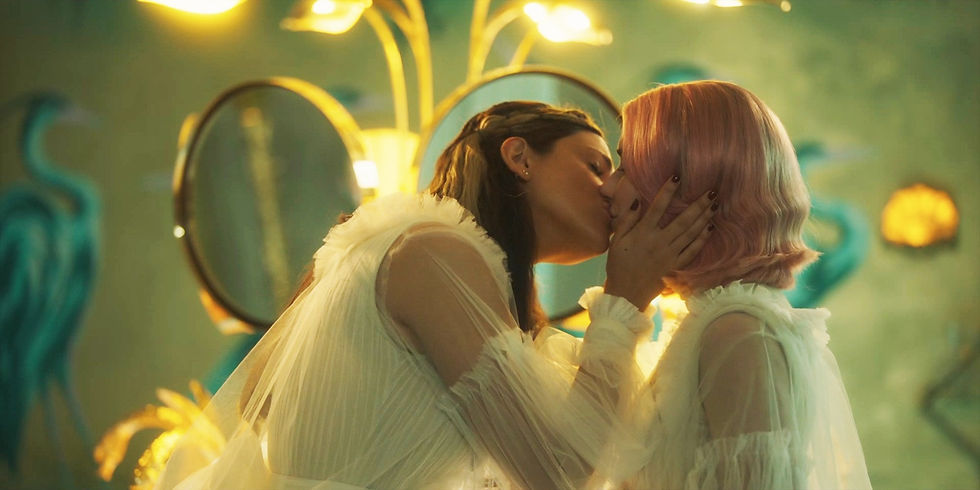
Credit where credit is due – this film is at least trying to be diverse. One of Uma’s friends, Chloe (Danielle Macdonald) is plus size but happy with her weight, and the other is Asian American actress Awkwafina. The love triangle also is between Uma, her old boyfriend and a star (Armana, played by Eiza González) she meets at Paradise Hills. Roberts and González have great chemistry onscreen and the fact in ended on an onscreen kiss was honestly a pleasant surprise.
Unfortunately, the film still ended with the classic bury your gays trope, and Uma is the least interesting of the main three, (this white girl is so different from everyone because of her coloured hair, I guess. Which is coloured again in the movie…) which leaves the diversity in this film feeling half-hearted. The discussion on fatphobia goes nowhere and Yu is forced to leave her headwear behind, ultimately conforming to what the girls were so against in the first place. And that’s part of the problem – the characters don’t have anywhere to grow in this story and ultimately fall pretty flat.
The twist in the plot was interesting, though. And it helped to justify the non-linear narrative of the film. It’s unfair to say that I saw it coming because I’ve read Horrowitz’s Alex Rider series, but that certainly affected my viewing experience. Otherwise, it would be a good twist.
And what does the twist say in the discussion of conformity? That, inevitably, someone who does conform will take your place, therefore non-conforming is pointless? I don’t know and it doesn’t seem the film does either.
Maybe it’s harsh to talk about the deeper meaning of this film, but it calls itself a science fiction film and science fiction has a history of using its genre to talk about society – from Frankenstein to War of the Worlds to The Handmaid’s Tale. Therefore, it feels right to consider if it is trying to say something.
Overall, this is a film that is lovely to look at for all of its strange fairy-tale aesthetic. My particular favourite was the carousel horse movie theatre because of how insane that is to explain to anyone. Paradise Falls certainly lives up to the image of its name, but its characters and plot make it a glass jewel. Very flashy, with little substance.


Comments