


Occulus (2013) - Mind-Bending


Occulus (2013) is earning its place as a quiet, classic of the horror genre. It has the soft, eerie chills contrasted with toe-curling injuries that's a classic of director Mike Flanagan's work.
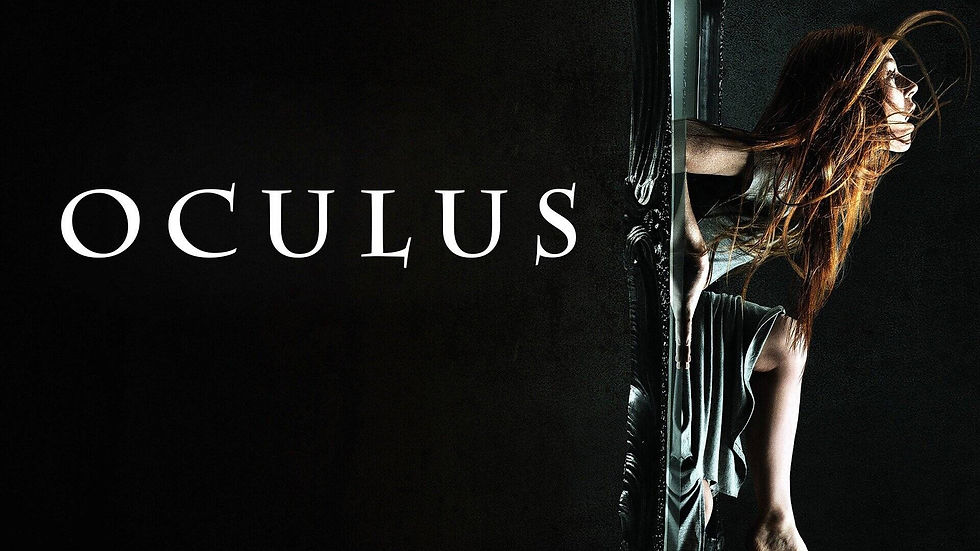
Kaylie Russell (Karen Gillian) has, after years of searching, got hold of a mirror. The same mirror from the house that she and her brother moved into as children. The same mirror, she believes, that has supernatural powers that drive its owners to commit depraved acts. Kaylie is going to prove this. She and her brother, Tim (Brenton Thwaites), are going to record the mirror, back in their family home, and prove its powers, once and for all.
The heart of Oculus is it's strong characters. The contrast between Kaylie, the believer, and Tim, who's spent the last ten years coming to terms with his past. Both are fleshed out and understandable characters, dealing with their parent's deaths in their own ways, ultimately looking for a way to reunite with each other. The slow pace allows us to genuinely like both of these characters, and want them to survive.
Much of Oculus isn't real. The mirror leads its characters through visions they are periodically pulled back from.
Like a lot of Flanagan's work, Oculus is split between two timelines, the present, and the past. Through flashbacks, we piece together what happened ten years ago. And it is piecing it together; we're never shown or told any more than we need to understand the events. The lack of details - only seeing the chain on the wall - are what make it more chilling, as our minds are forced to fill in the gaps. It's the half-remembered, fractured scenes that get us in the mind of how our protagonist's remember past events.
Because Kaylie and Tim are feeling the effects of the mirror again. It begins twisting reality around them, until no one is sure what is real, and what's not. Ordinarily, this can be frustrating experience - what's the point of paying attention if the slate is going to be wiped clean? Here, it leans into that, as the pair become more and more frustrated themselves. It captures the feeling of knowing you're dreaming, and waking, only to find you're still dreaming. Instead of wondering if what you're seeing is real, you're wondering how this will be in reality - who is the person Kaylie's seeing, really?
It helps, of course, that the hallucinations are so memorable, feeding into the intrusive thoughts we've all had. I only need to say lightbulb, and you know the exact scene I mean. (I know I can never think of a staple remover the same way again.)
The mirror itself is also interesting. We're presented with an enjoyably gruesome recounting of its history that would be at home on any unsolved mysteries podcast, and then we are left to wonder about what the mirror truly is. It's never concretely confirmed, and that's what makes it intriguing; the mystery remains unsolved.
Really, the only time it starts to overstep is when ghosts start appearing; it feels a little too concrete of a haunting and a little too overused for a film that's otherwise unique.
Oculus definitely deserves its reputation of an underrated, psychological, sleepwalking session.


This is a pretty good article.