


Ari Aster and the Horror of Mental Illness

Updated: Jan 24, 2022

Midsommar begins with a cold open on a murder-suicide. This is an Ari Aster film, after all, and therefore has to be as chock-full of shock horror as possible. Whilst I didn’t think much of Hereditary, I watched Midsommar as it came onto Netflix, and there seemed to be a different running theme that made me go ‘hm.’
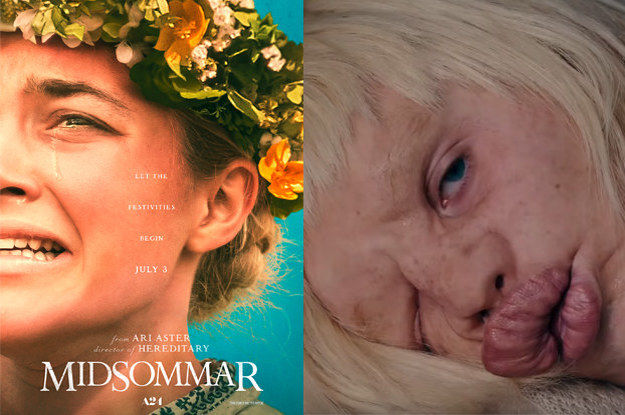
Dani’s (Florence Pugh) sister is suffering from mental illness. Unspecified mental illness that the narrative frames as an inconvenience to everyone around her. She’s controlling Dani’s life to the point where her relationship is tightly strained, and her actions at the movie’s open serve, essentially, as a plot device. The murder-suicide is what puts Dani in a vulnerable emotional state to start with. Otherwise, she might not have been so easily coerced by the cult. There’s no sympathy for Dani’s sister. We only see the external – how much of a burden she appears to everyone around her.
Not a great message to anyone struggling with mental health. A terrible one, in fact, and the fact that the devastating consequences it has is a trivial plot device is – troubling.
Still, this might not have been the intention. We are, after all, following Dani, not her sister. And it may have just been a slightly awkward way of laying down the cult grooming that takes up the bulk of the film. I’d be willing to just note it down as something in poor taste, if there wasn’t a few other – strange things – happening.
Rueben. (Levente Puszkó-Smith) A character who barley has any screen time, and yet works their way onto a lot of Youtube thumbnails for the shock factor of their appearance. This is a character who is the product of incest within the cult, and as a result is physically and (implied) mentally disabled. It is completely unclear how old they are, or how much of an understanding they have of the world around them. Their role is to draw in ‘the book,’ – seemingly just to show the audience how ‘weird’ and ‘crazy’ the cult is. (The idea of religion and cult, and any overlap is another can of worms, and something that should be given the time it needs to be explored properly.)
In the few minutes of screen time they have, they are treated like a ghost, or monster. Something to pop out of the shadows and scare the audience. Since the film isn’t supernatural, it does make sense to have a character stand into the ‘villain’ role, but it does hit differently when that character is a young person who looks and thinks differently. The implication is that this person is scary for their looks and scary for their mind, when they are, simply, disabled.
Not a good message to send to any audience. Not coupled with the opening of the movie portraying mental illness as an inconvenience and burden to all those around you, resulting only in tragedy.
It’s not just Midsommar that seems to have this ideal. If it was, it could actually lend itself to the films theming of deception, illusion and instability. (After all, we leave Dani in a devastating mental state.) There’s a worryingly similar correlation in Ari Aster’s other big hit – Hereditary.
Most of the reviews and talk about this film were about how the girl who played Charlie (Millie Shapiro) was great – was very scary. Originally, I thought that the actress had a cleft palate corrected in the past, then found out that she has a condition called cleidocranial dysostosis. It’s brilliant that all of her acting roles have disregarded this, and from her previous work, it’s clear that she has a great talent.
Yet – in Hereditary – Charlie is heavily implied to be autistic. Couple this with the fact she is played by an actress who looks ‘different’ and we get – something horribly similar to Rueben. Someone who is different, and portrayed as the monster. (At least Charlie is a ghost, and not just – a person. Existing.) Furthermore, the bit that scared everyone, it seemed, was the popping sound Charlie made with her mouth. This seemed to be a stim of hers, only presented like Krueger’s screeching knife fingers – a warning that the villain was near.
What kind of a message is this? To have the youngest member of the cast portrayed as the terrifying ghost? To prop up an autistic child as something to be feared?
It didn’t sit well with me, then, and it doesn’t sit well with me now. We get very little of Charlie’s point of view, or how she sees the world. It others her completely.
Coupled this with the othering going on in Midsommar and we get a startling similarity. An othering of the physically and mentally different.
Horror’s had a long history of this. Othering is usually employed to make a group seem alien and terrifying, as Heinlein did with communism in Starship Troopers. It’s shocking, and saddening, that this is still a trend. Even worse that it’s still focused on ableism. The worst that children are dragged into it.
It’s a correlation I noticed that didn’t sit well with me. Hopefully, it isn’t a trend continued with Aster’s future films. Once is a mistake, twice is suspicious, but three times is deliberate.


Comments